'You're not going to die. And I don't lie.'
At a combat hospital in the heart of Taliban country, doctors
and nurses fight to save the war's worst casualties.

 At The Pilot, we are always looking for ways to make connections between news that's happening around the world and people here in Hampton Roads. The NATO hospital in Kandahar is staffed in part by doctors and nurses from Portsmouth Naval Medical Center, so it provides a powerful opportunity to apply a local lens to the war in Afghanistan.
This series offers a rare view of our military's bravery and sacrifice, and of the hospital staff's heroic efforts to save the lives of soldiers and Marines who have sustained horrendous wounds on the battlefield.
Some of the words and images you will see are graphic. We debated how unvarnished to be in our report. Ultimately, we felt a responsibility to illustrate the heavy toll that this 10-year-old war continues to take.
Denis Finley, Virginian-Pilot editor
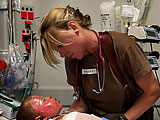
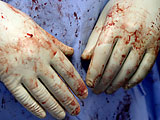
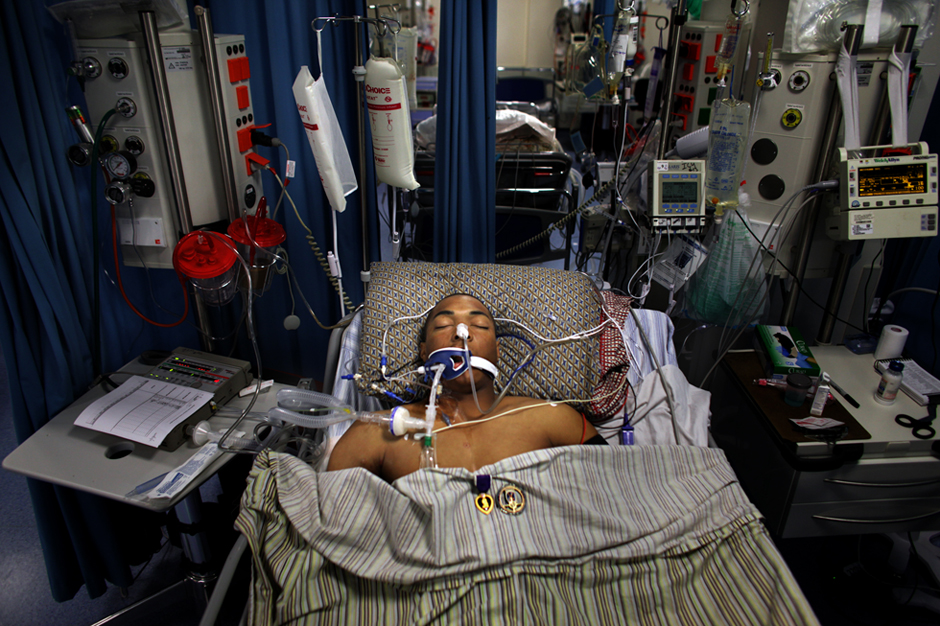
A note from the editor about the photos.
To our readers: These videos contain images of wartime injuries. Viewer discrection is advised.
Watch video No. 1 of five 
Watch all five videos
A note from the editor about the videos.
Download free Flash player to view videos:

The combat hospital at Kandahar Airfield is among the most advanced treatment facilities ever to operate in a war zone. Roughly 70 percent of its patients come straight from the battlefield. In addition to U.S. and coalition service members, the hospital treats Afghans. For the staff, every day is spent working to keep death at bay.
Spc. Nick Ganey with the Army's 10th Mountain Division, was inside a 15-ton armored vehicle when an IED flipped it upside down. He spent more than an hour trapped underneath in the turret.
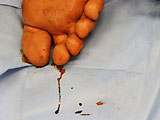
Ali, an Afghan toddler, was badly burned in a household accident. He was flown to the hospital with his grandparents. Doctors soon determined that he couldn't be saved.
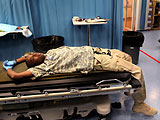
Army Cpl. Eddie Ward, 19, lost most of his right leg in a land mine explosion. He was rushed to the hospital, then into surgery. Explosive devices are responsible for the vast majority of injuries here.
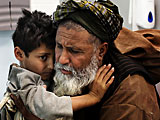
A boy the staff calls Sam 80, who's about 10, was walking home with his brother in February when an IED exploded. He spent weeks in the intensive care unit, and during that time, he formed a close bond with the staff.


the hospital staff
Meet some of the caregivers included in this series
-

Lt. Joelle Annandono
is a Navy physician assistant who specializes in orthopedics. She's based in Bremerton, Wash. -

Petty Officer 3rd Class Bryce Moheit
is a hospital corpsman and surgical technician. He's based in Bremerton, Wash. -

Cmdr. Julie Wetmore
is a Navy reservist and neonatal nurse practitioner. Back home in Illinois, she works at St. Louis Children's Hospital. -

Lt. Cmdr. Kirk Sundby
is a Canadian orthopedic surgeon. -

Cmdr. Jim Sullivan
is a Navy reservist and ER doctor. Back home, he heads the emergency department at Harrington Hospital in Southbridge, Mass. -

Lt. Cmdr. David Shellington
is one of six pediatric intensive care physicians in the Navy, and the only one working in Afghanistan. He's based in Portsmouth. -

Cmdr. Christian Peterson
is a Navy anesthesiologist who specializes in pediatrics. He's based in Portsmouth and lives in Suffolk. -

Navy Capt. Tim McCullough
is the hospital's director of surgery. He's based in Portsmouth and lives in Suffolk. -

Col. Tom Curry
is an Army surgeon based at Fort Lewis, Wash. -

Lt. Cmdr. Tom Shu
is a flight and critical care nurse. He enlisted in the Navy 20 years ago, then went to nursing school. Now he's a reservist. He lives in Washington, D.C. -

Lt. Cmdr. Ron Bolen
heads the hospital's trauma department. He's a Navy reservist. Back home in Nashville, Tenn., he's a flight nurse for Vanderbilt Medical Center.
From the editor
Why we are publishing this story
Read more
Ways to help
Organizations that support deployed service members, wounded warriors and Afghan victims
Read more

In their own words
Service members share how working at the hospital has changed them Read more
The Pilot's Corinne Reilly and Ross Taylor talk with WHRV's Cathy Lewis about the series.
WHRV site | Download podcast
- Meredith Kruse, military editor
- Randall Greenwell, director of photography
- Thé Pham, photo editor
- Brian J. Clark, multimedia producer
- David M. Putney, online producer
- Tom Justice, copy editor
Credits

Corinne Reilly, reporting

Ross Taylor photography and video
-
part 1 | A CHANCE IN HELL
The hospital is among the most advanced ever to operate in a combat zone. Nearly three-quarters of its patients arrive straight from the battlefield. 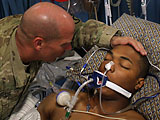
part 2 | fighting for life
In this job, where staving off death is part of daily life, avoiding emotional involvement is best. It's also impossible.-
part 3 | BLOOD AND GRIT
If IEDs are the war's signature weapon, then the painstaking work of cleaning out blast wounds is its signature surgery. -
part 4 | The littlest casualties
Although the hospital was designed to save soldiers, it's taken on another job: treating Afghan civilians, many of them children. -
part 5 | 'It's never enough'
For the hospital staff, the hardest part is learning to accept that they can't fix Afghanistan.
Read the five-part series
Pilot reporter Corinne Reilly and photographer Ross Taylor spent two weeks this spring in Afghanistan with the staff of the NATO hospital in Kandahar. Their job is to save the most critical casualties in the most unforgiving war zone. Since 2001, more than 100 doctors, nurses and corpsmen from Portsmouth Naval Medical Center have served there.